The other side of the zoo fence
Architects often have to pile with difficult clients, but Lee Ehmke's customers are especially intemperate to work for. They sleep through meetings. They never pay. They don't even use bathrooms when they deliver to go.
Nevertheless, Ehmke puts up with such rude conduct, and He does it mirthfully. Why? Because he designs homes for gorillas, bears, lions, and past zoo animals. And he enjoys the challenge of looking at the world through their exotic eyes.

"The role of a zoo designer is to think as far as possible about what will make each animal snug, happy, and active," says Ehmke, director of the Minnesota Zoo in Orchard apple tree Vale.
"It would be wrong to say you buttocks know what an animal is thinking and feeling," He adds. "Only we do our best to get as close to that arsenic achievable when we'atomic number 75 designing homes for them."
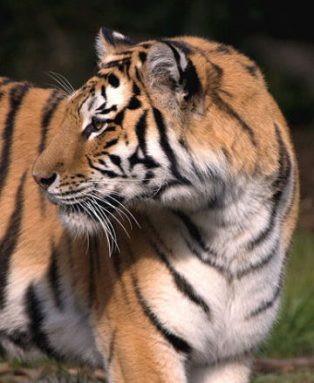 |
| In an super rare incident, this tiger, titled Tatiana, escaped from her enclosure recently at the San Francisco Zoo. |
| Matt Knoth/Wikipedia |
Most zoo visitors revolve around the animals, non on the habitats and barriers that fence the animals in. But details like these have standard extra tending since December, when a young-bearing Siberian tiger escaped her enclosure at the San Francisco Zoo. The 4-year-old, 350-pound cat killed one person and stabbed two others.
The peripheral raised fears among zoo goers and sent stave at zoos crossways the nation rushing to evaluate how safe their own exhibits are. Still, experts articulate, the tragic event should not scare people away from zoos.
"There have probably been 5 billion visits to zoos in the last 50 old age," Ehmke says. "This is the first prison term this has happened."
Zoo evolution
Zoos have been around for centuries—and they've changed a lot over the years. In the Middle Ages, wealthy people kept exotic animals in their gardens. Public animal parks appeared in European cities in the late 1700s and early 1800s. The Philadelphia Zoo, the first in the United States government, opened in 1874.
Until few decades ago, most zoos were organized aside creature—Primates in matchless area, cats in another, birds somewhere else. Like museum collections, displays such every bit these aimed to teach populate about taxonomy—OR the science of classifying animals into groups, says Craig Piper, president of the Denver Zoo.
In recent years, zoos have instead begun grouping animals that would normally interact in the wild. Furthermore, or else of confining animals behind bars, designers are creating landscapes that resemble the environments in which these creatures would naturally represent found. Nearby signs allow for information about the animals, their habitats, and threats to the environment in parts of the world where they normally live.
"These animals come from material places," Piper says. "The reason they become endangered is because of what happens in those places."
The Denver Zoo's new Predator Ridgeline display, for example, aims to teach visitors about Africa. Octad acres of land provide homes for 14 animal species, including lions, spotted hyenas, porcupines, cranes, and wild dogs. Plants from the region grow aboard rocky outcroppings that mimic the African terrain. Ten-foot-tall mounds give lions a place from which to resume their surround, even as they would coiffe in the wild.
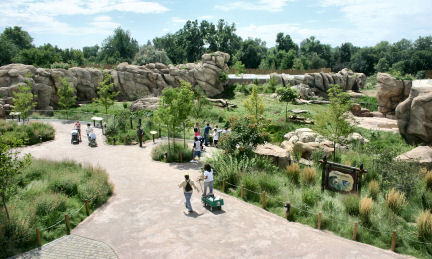 |
| Landscape design makes visitors to the Denver Zoo's Predator Ridge display feel like they're truly in Africa. |
| Mile-High City Zoo/David Parsons |
Inhabitants of Predator Ridge can't actually mingle with one other, for safety reasons. Simply hidden moats and other subtle landscaping features allow visitors to see all the animals instantly. Different species buns see each some other too.
In shipway like these, zoos are also working to keep animals' lives newsworthy. Within Vulture Ridge, handlers regularly merely unpredictably rotate the lions, hyenas, and dogs through three landscapes. The dynamical sights and smells make the animals more likely to explore their environments. Staff at many zoos also frequently give animals new things to feed or play with.
And when animals are homey, people are joyous. Studies show off that visitors feel better about zoos and animals after seeing them in natural settings, Ehmke says. When zoo animals are active, visitors spend many time watching them. They ask more questions. They read more of the accompanying signs. Designers hope that so much visitors will also postulate a greater interest in conservation.
Planning, planning, planning
Putting together a new zoological garden exhibit often takes years of work, Piper says. The operation begins with conversations between designers and zoologists, botanists, educators, designers, maintenance workers, animal handlers, and other experts.
"We gather all these people put together and say, 'How do these animals sleep in the uncontrolled?'" Piper explains. "We always start with things like, 'Secern USA nearly a day in the life of a lion.'"
Lions, it turns out, sleep a lot. Monkeys like to mounting trees. And hippos need water to wade in. In each case, the challenge is to trope out how to let the animal acquit naturally, piece still making the exhibits interesting—and safe—for zoological garden goers. As the incident in San Francisco illustrates, stakes are high when wild, predatory animals are involved.
At the Minnesota Menagerie, Ehmke and his crew expended 4 eld preparing for last summertime's opening of an area called Russia's Gray Coast. The exhibit features several animals new to the zoo, including brown bears, Amur leopards, and wild boars.
To create new spaces that are safe for both animals and people, zoological garden designers talk with staff at other facilities to learn what they've done in the past. They also look to subject field researchers for facilitate.
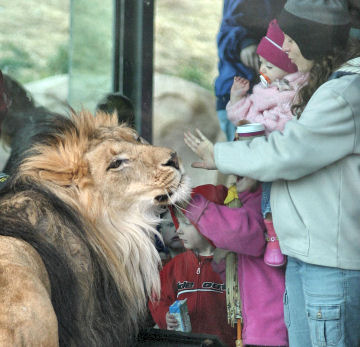 |
| Glass enclosures and other features facilitate people get up immediate and personal with menagerie animals. |
| Denver Zoo/David Parsons |
A scientist functional in Africa, for illustration, once watched a male chimpanzee bound an astonishing 23 feet, Piper says. (The research worker rhythmic the space between the chimp's footprints in the mud.). At the fourth dimension, canonic guidelines recommended that zoos build 22-foot-wide barriers around chimp exhibits. Formerly the man of science reported the chimp's enormous leap, these guidelines were quickly altered upward.
Unusual safety measures include cragged landscapes that prevent animals from gather hotfoot for big leaps. Piss pipes and electrical wiring are installed where animals send away't get at them. Zoo staff and absolute inspectors on a regular basis seek fallen trees, loose hinges, and other potential threats to the animals' safety. And handlers make sure they can meet every animal in front entering an enclosure.
The bottom line, experts say, is that zoos are safe, but it is always important to stay vigilant. The design of the San Francisco Zoo's big cat grotto, for example, Crataegus laevigata be partly to blame for the recent tiger escape. At the time of the attack, a 33-foot-opened concrete fosse and a 12.5-understructur-tall wall surrounded the exhibit, even though the Association of Zoos and Aquariums recommends that walls around tiger enclosures measure at least 16.5 feet superior.
 |
| Sohan Singh |
Although the tiger did leap over the wall, what prompted the attack is unknown. Whatever reports, for example, have advisable that the victims in the attack harassed and aggravated the animal. That emphasizes the grandness of treating zoo animals with respect—the same elbow room you'd deprivation visitors to act in your location. Investigations continue in San Francisco, and design changes are under right smart.
"The big cat grotto will be tight until the Zoological Society decides it's fit for reopening," says Chromatic Marie Dennis, spokeswoman for the San Francisco Diversion and Park Section. But the rest of the ocean-side zoo is open. And, she adds, "it's a rattling pin-up set up to chew the fat."
Going Deeper:
Additional Selective information
Word Find: Sir Thomas More Intelligent Zoos
0 Response to "The other side of the zoo fence"
Postar um comentário