Lyrics in a Row Back in I Dont Get It Keep It Down Did It Again
| "Go Back" | ||||
|---|---|---|---|---|
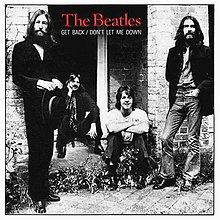 Picture sleeve for 1989 Great britain reissue | ||||
| Single by the Beatles with Billy Preston | ||||
| from the album Permit It Exist | ||||
| B-side | "Don't Let Me Downwards" | |||
| Released | eleven April 1969 (1969-04-eleven) | |||
| Recorded | 27–28 January 1969 | |||
| Studio | Apple, London | |||
| Genre | Stone | |||
| Length | 3:09 (album version) 3:xiii (single version) | |||
| Label | Apple | |||
| Songwriter(s) | Lennon–McCartney | |||
| Producer(due south) | Glyn Johns and George Martin (unmarried version) Phil Spector (anthology version) | |||
| The Beatles singles chronology | ||||
| ||||
| Billy Preston singles chronology | ||||
| ||||
| Audio sample | ||||
| "Go Back"
| ||||
"Get Back" is a vocal recorded past the British rock band the Beatles and written by Paul McCartney (though credited to Lennon–McCartney), originally released as a single on xi April 1969 and credited to "The Beatles with Billy Preston".[ane] The album version of this song contains a unlike mix that features a studio conversation between Paul McCartney and John Lennon at the outset which lasts for 20 seconds before the vocal begins, also omitting the coda featured in the single version. This version became the closing track of Let It Be (1970), which was released only after the group divide. The unmarried version was after issued on the compilation albums 1967–1970, 20 Greatest Hits, Past Masters, and 1.
The single reached number one in the U.k., the United States, Ireland, Canada, New Zealand, the netherlands, Commonwealth of australia, France, West Germany, Mexico, Norway, Switzerland, Austria, and Kingdom of belgium. It was the Beatles' merely unmarried that credited another artist at their request. "Go Back" was the Beatles' starting time single release in true stereo in the US. In the Uk, the Beatles' singles remained monaural until the post-obit release, "The Ballad of John and Yoko". It was also the first single to debut on the singles charts at number one.
Limerick [edit]
Musical development [edit]
"Get Back" is unusual in the Beatles' canon in that almost every moment of the vocal'southward evolution has been documented, from its beginning as an offhand riff to its final mixing in several versions. That is covered in bootleg recordings, books,[2] the 1970 documentary Allow It Be, and the 2021 Peter Jackson-directed documentary The Beatles: Get Back.
The song'southward melody grew out of some unstructured jamming on vii January 1969, during rehearsal sessions on the sound phase at Twickenham Studios.[2] Later working out the rhythm and harmony of the primary riff on his Höfner bass, McCartney introduced some of the lyrics, reworking "Go dorsum to the place you should be" from beau Beatle George Harrison'due south "Sour Milk Ocean" into "Get dorsum to where you once belonged".[3] McCartney had played bass on Jackie Lomax's recording of "Sour Milk Sea" a few months earlier. On 9 January, McCartney brought a more developed version of "Get Dorsum" to the group, with the "Sugariness Loretta" verse close to its finished version. For the press release to promote the "Get Dorsum" single, McCartney wrote, "Nosotros were sitting in the studio and nosotros made it up out of thin air ... nosotros started to write words there and then ... when nosotros finished it, we recorded it at Apple Studios and fabricated it into a song to roller-declension by."[4]
At the beginning of the Let It Be version of the song, Lennon can be heard jokingly proverb "Sugariness Loretta Fart (oft misheard as "fat", due to Lennon's pronunciation),[five] she thought she was a cleaner, but she was a frying pan." The anthology version of the song also ends with Lennon famously quipping "I'd similar to say thanks on behalf of the group and ourselves, and I hope we passed the audience".[6] (He had said that at the stop of their xxx January 1969 rooftop concert on the roof of Apple Studios, but Phil Spector edited it into the studio version of "Become Back" that was released on the Let Information technology Be anthology.)[half dozen]
In an interview in Playboy mag in 1980, Lennon described "Go Back" as "... a better version of 'Lady Madonna'. You know, a potboiler rewrite". Lennon likewise said that "there's some underlying thing about Yoko in there", saying that McCartney looked at Yoko Ono in the studio every time he sang "Get dorsum to where you once belonged."[seven]
Early protest lyrics [edit]
When McCartney introduced the song to the group during the Twickenham rehearsals, the lyrics were mostly incomplete except for the "Get Back" chorus. McCartney improvised various temporary lyrics leading to what has become known in Beatles' folklore as the "No Pakistanis" version. This version parodied the anti-immigrant views of Enoch Powell, a Member of Parliament (MP) whose racially charged speeches, particularly the Rivers of Blood speech, had recently gained much media attention.[8] The lyrics addressed attitudes toward immigrants in the The states and the U.k.: "... don't need no Puerto Ricans living in the USA"; and "don't dig no Pakistanis taking all the people'southward jobs", though these lyrics were meant to exist a parody and a criticism of those prejudiced confronting immigrants.[9] Subsequently during the same session, the subject of clearing came upward once more in an improvised jam that has get known as "Commonwealth". The lyrics included a line "You'd amend go dorsum to your Democracy homes".[10]
On 23 January, the group (now in Apple tree Studios)[11] tried to record the song properly; homemade recordings preserve a conversation between McCartney and Harrison between takes discussing the song, and McCartney explaining the original "protest song" concept. The recording captures the grouping deciding to driblet the 3rd poesy largely because McCartney does not experience the verse is of high enough quality, although he likes the scansion of the word "Pakistani". Here the song solidifies in its ii-poetry, 3-solo format.
Recordings and mail service-product piece of work [edit]
Billy Preston, an sometime friend of the Beatles, was in England for some goggle box appearances. He joined the Beatles on keyboards from 22 January. The group, with Preston playing Fender Rhodes electric piano, recorded near 10 takes on 23 January. They fabricated a concerted effort to perfect "Get Back" on 27 January, recording nigh 14 takes. By this time the song had the addition of a faux ending and reprise coda. Later numerous takes, the band jammed some sometime numbers and so returned to "Become Back" one last time in an attempt to record the master take. This functioning (Accept xi) was considered to be the best still: it was musically tight and punchy without mistakes, though the song finishes without the restart. On the session tape, George Harrison comments "we missed that cease"; this is the version heard on the Let It Exist... Naked anthology. On 28 January[2] the group attempted to recapture the previous 24-hour interval's operation and recorded several new takes, each including the coda. Whilst these takes were adept, they did not quite achieve the quality of the best take from the previous twenty-four hour period. The line-up for the released versions of "Get Back" was Paul McCartney, lead vocal and bass; John Lennon, lead guitar and bankroll vocal; George Harrison, rhythm guitar; Ringo Starr, drums; and Billy Preston, electrical piano. Harrison, the usual pb guitarist, had temporarily quit the group on ten January, so Lennon worked out the lead guitar function himself and played it on the recordings.
The Beatles had EMI produce a mono remix of the track on 4 April,[12] completed by Jeff Jarrett. The Beatles were unhappy with the mix and on vii April McCartney and Glyn Johns worked at Olympic Studios to produce new remixes for the unmarried release.[1] They made an edited version using the best take of the chief function of the vocal (Have xi) from 27 January and the 'all-time coda' catastrophe from 28 January. The edit is so precise that information technology appears to be a continuous take, achieving the ending the Beatles had desired all along. This was a difference from the concept of straight alive functioning without studio trickery, but a relatively minor ane, and avoids the somewhat abrupt ending of the version that is used on the Let It Be... Naked anthology.[ commendation needed ]
The Beatles performed "Get Back" (along with other songs from the album) as part of The Beatles' rooftop performance, which took identify on the roof of Apple Studios in Savile Row, London on xxx January 1969, an edited version of which was included in the Allow It Exist film. "Get Dorsum" was performed in full three times. During the third, which marked the cease of the rooftop operation, the Beatles were interrupted by the police who had received complaints from office workers nearby. After the police spoke to Mal Evans, he turned off Lennon and Harrison's amplifiers just for Harrison to switch them back on, insisting that they finish the song. McCartney said, "You've been playing on the roofs again, and that's no good, and y'all know your Mummy doesn't like that ... she gets angry ... she'south gonna have you arrested! Get back!" The tertiary rooftop performance of "Get Back" is available on Anthology 3: the concluding vocal of the Beatles' final live performance.
At the cease of the last rooftop performance of "Get Dorsum", the audience applauds and McCartney says "Thank you, Mo" in reply to Maureen Starkey'due south auspicious. Lennon adds: "I'd similar to say cheers on behalf of the group and ourselves and I promise we've passed the audience".[6] Spector used some of the talk preceding the master accept of 27 Jan and edited on these comments to make the anthology version sound unlike from the single.[vi]
The stereo single version, and that of the B-side, "Don't Allow Me Down", were the start Beatles recordings to feature Starr's drum kit in truthful stereo, mixed across the left and right channels. This utilised the then-fairly new 8-track recording engineering science and was a result of the growing popularity of stereo over mono. The just other Beatles' track to employ this recording method was "The End" on Abbey Road.
Releases [edit]
Single version [edit]
On 11 April 1969, Apple tree Records released "Get Back" every bit a unmarried in the UK, paired with "Don't Let Me Downwards" on the B-side. The unmarried began its 17-calendar week stay in the charts on 23 April at No. i, a position it held for six weeks. Information technology was the first Beatles single to enter the official U.k. singles chart at the top.[xiii] In the US, "Get Back" began its beginning of 12 weeks on the Billboard Hot 100 chart the calendar week catastrophe x May. Ii weeks afterwards the song's chart debut it hit No. ane, where information technology stayed for five weeks. "Get Back" became the ring'due south 17th No. 1 song in Billboard, matching Elvis Presley's previous record of 17 number ones.
In both the UK and The states, the unmarried was released by Apple, although EMI retained the rights to the song equally function of their contract. It was the only Beatles' single to include an accompanying artist's name, crediting "Get Dorsum/Don't Permit Me Downward" to "The Beatles with Billy Preston". Neither Apple tree nor Capitol Records created a picture sleeve for the single—information technology was simply packaged in a sleeve stating "The Beatles on Apple".[14] Apple launched a impress advertizement campaign for the song concurrent with its release showing a photo of the band with the slogan The Beatles as Nature Intended, indicating that the sound of "Go Back" harked to the group's earlier days.[15]
The single version of the song contains a chamber reverb outcome throughout and a coda after a false catastrophe, with the lyrics "Go dorsum Loretta / Your mommy'south waiting for y'all / Wearing her high-heel shoes / And her low-cervix sweater / Get back habitation, Loretta." This does not appear on the album version; the single version'south first LP appearance would come up iii years later on the 1967–1970 compilation. This version also appeared in the albums 20 Greatest Hits, Past Masters and 1. It was also included in the original line-upwards of the proposed Become Back album that was scheduled to be released during the fall of 1969.
In the UK and Europe "Get Back/Don't Allow Me Downward" was the Beatles' final single to be released in mono, but in the US the single was released in stereo. Information technology was the Beatles' first unmarried to exist released in true stereo instead of mono as part of the "stereo only" movement gaining force in 1969. In both versions the lead guitar played by Lennon is in the left aqueduct, and the rhythm guitar played past Harrison is in the right channel. The unmarried was also released in the experimental PocketDisc format by Americom in conjunction with Apple and Capitol in the late 1960s.
Let It Be version [edit]
When Phil Spector came to remix "Go Dorsum" he wanted to make it seem unlike from the version released as the unmarried, though both versions were essentially the same accept. The unreleased Get Back albums included elements of studio chatter to add together to the live experience of the recordings. In this spirit, Spector included function of the studio chatter recorded immediately before a take recorded on 27 January, slightly crossfaded it onto the offset of the master take (also recorded on January 27), and omitted the coda recorded on January 28, instead adding McCartney and Lennon's remarks afterwards the close of the rooftop operation. This created the impression that the single and album versions are unlike takes. The unmarried's reverb effect was also omitted from this remix.
Let Information technology Be... Naked version [edit]
In 2003, "Get Back" was re-released on the Allow Information technology Be... Naked album, remixed past contained producers with the sanction of surviving Beatles Paul McCartney and Ringo Starr, with John Lennon's and George Harrison'due south widows. The "Naked" version of "Go Back" is a remix of the take recorded on 27 January 1969 used for both the single and album versions, without the coda recorded the following day or the framing dialogue from the studio and rooftop concert added to the album version.[16] The single'south reverb issue was as well omitted from this remix, and the song fades immediately earlier the last "whoo". Apple tree also prepared a specially-created music video of the Let Information technology Be ... Naked release of the song to promote that album in 2003. This video is edited together using stock footage of the ring, along with Billy Preston, George Martin and others.
Dearest version [edit]
In 2006, a newly mixed version of "Get Back" produced by George Martin and his son Giles was included on the album Dearest. This version incorporates elements of "A Difficult Twenty-four hours's Night" (the intro chord), "A Day in the Life" (the improvised orchestral crescendo), "The End" (Ringo Starr's pulsate solo, Paul McCartney'southward second guitar solo, and John Lennon's last guitar solo), and "Sgt. Pepper's Alone Hearts Club Band (Reprise)" (Take 1's drum count-off intro).[17] Even so, there are several edits in this piece, including an extended intro, and the second poesy is removed completely.
The Beatles: Become Back versions [edit]
Universal Music released take 8 from the recording sessions to promote the 50th anniversary edition of Permit It Be and the 2021 Become Back documentary miniseries. This version has McCartney ad libbing a dissimilar spoken word department over the span, offset with "It'due south five o'clock ... your female parent'southward got your tea on."[18] Equally the band performed the song three times during their impromptu rooftop concert on xxx January 1969, all three of those versions also appear in the final episode of the mini-series, as the concert is shown in its entirety.
McCartney live performances [edit]
McCartney performed "Go Dorsum" on the Late Show with David Letterman on 15 July 2009. Letterman's show was taped in the Ed Sullivan Theater, the same theatre that hosted the Beatles' performances on The Ed Sullivan Show in 1964 and 1965. McCartney's performance was non on the stage, nevertheless. Instead, he performed atop the theatre's marquee overlooking Broadway. In the interview preceding the performance, Letterman asked McCartney if he had always played on a marquee before. "I've washed a roof", McCartney replied, referring to the Beatles' 1969 performance atop the Apple Corps building in London.[19] [twenty]
McCartney also performed the song as a kind of encore on Saturday Nighttime Live on xi Dec 2010. The performance was unusual for the show because McCartney had played the two standard songs that musical guests play, then had played a third vocal ("A Day in the Life"/"Requite Peace a Hazard"). At the normal conclusion of the testify, when host Paul Rudd thanked the cast, McCartney took the phase again for "Go Back", the broadcast of which was partially cut off due to time constraints.
McCartney performed this live during his 1989/1990 World Tour, and it was released on both the full-length and highlights versions of the subsequent live anthology Tripping the Live Fantastic (1990). In 2014, a functioning was included on the Good Evening New York City album.
Personnel [edit]
- Paul McCartney – lead vocal, bass guitar
- John Lennon – pb guitar, harmony vocal
- George Harrison – rhythm guitar
- Ringo Starr – drums
- Baton Preston – Rhodes piano
Notable comprehend versions [edit]
- Rod Stewart covered the song for the 1976 musical documentary All This and World War II.[21] The song was released as a single and information technology reached No. 11 on the Great britain chart.[22]
- Billy Preston, in the picture Sgt. Pepper's Lone Hearts Order Band and released on Sgt. Pepper'southward Lonely Hearts Club Ring: Original Motion Film Soundtrack (Various Artists, 1978).
- Steve Wariner, in 1995 for the Beatles tribute album Come Together: America Salutes the Beatles. Wariner's version peaked at No. 72 on the Billboard Hot Country Singles & Tracks chart.[23]
Cultural references [edit]
- In the 2007 picture, Across the Universe, directed past Julie Taymor, most characters are named afterward lyrics in Beatles songs. A principal character is named Jojo, an African American who was played by Martin Luther McCoy.[24]
- In February 2010, NBC used a cover of the song in commercials to promote Jay Leno'southward return to the 11:35pm time slot for The Tonight Bear witness with Jay Leno.[25]
Charts [edit]
Certifications and sales [edit]
Notes [edit]
- ^ a b Lewisohn 1988, p. 172.
- ^ a b c Sulpy & Schweighardt 2003, p. 84.
- ^ Sulpy & Schweighardt 2003, p. 152.
- ^ The Beatles 2000, p. 319.
- ^ The Mike Douglas Evidence. vii February 1972.
- ^ a b c d Lewisohn 1988, p. 169.
- ^ Sheff 2000, p. 201–202.
- ^ Whatley, Jack (14 October 2020). "The controversial racist lyrics removed from The Beatles classic track". Far Out Magazine . Retrieved 31 December 2021.
- ^ Sulpy & Schweighardt 2003, p. 153.
- ^ Sulpy & Schweighardt 2003, p. 158.
- ^ Lewisohn 1988, p. 166.
- ^ Lewisohn 1996a.
- ^ "Number One Hits: Facts & Feats: Direct In At Number One". Retrieved 13 December 2013. (On the NME chart, 8 earlier Beatles singles had entered at the top.)
- ^ Spizer, Bruce (2003). The Beatles on Apple tree Records. 498 Productions. p. 47.
- ^ "The Beatles as nature intended" (PDF). Billboard. New York Metropolis. 26 April 1969. Retrieved 30 Jan 2018.
- ^ Winn, John C. (2009). That Magic Feeling: The Beatles' Recorded Legacy, Volume Two, 1966-1970. New York City: Three Rivers Printing. pp. 256–257. ISBN978-0-307-45239-nine.
- ^ Miami Herald 2006.
- ^ Kreps, Daniel. "Hear the Beatles' Unreleased 'Get Dorsum (Take eight)' From Upcoming 'Let It Exist' Reissue". Rolling Stone . Retrieved 19 September 2021.
- ^ "Paul McCartney Stuns Manhattan With Set on Letterman's Marquee". Rolling Stone. 16 July 2009. Retrieved 28 Nov 2014.
- ^ "McCartney Rocks the 'Late Show'". CBS News. 15 July 2009. Retrieved 28 November 2014.
- ^ "All This and World State of war II". AllMusic . Retrieved 4 December 2011.
- ^ "Rod Stewart". The Official Charts Visitor.
- ^ Whitburn, Joel (2013). Hot Country Songs 1944–2012. Record Research, Inc. p. 358. ISBN978-0-89820-203-viii.
- ^ Holden 2007.
- ^ McKenzie 2010.
- ^ "Go-Set National Peak 40". Go-Set charts. vii June 1969.
- ^ "The Beatles with Billy Preston – Go Back" (in German). Ö3 Austria Tiptop 40. Retrieved sixteen May 2016.
- ^ "The Beatles with Billy Preston – Get Back" (in Dutch). Ultratop 50. Retrieved 16 May 2016.
- ^ "Acme RPM Singles: Outcome 6006." RPM. Library and Athenaeum Canada. Retrieved 16 May 2016.
- ^ a b "Hits of the World". Billboard. 81 (23): 63. 7 June 1969. ISSN 0006-2510. Retrieved thirteen November 2021 – via Google Books.
- ^ a b "The Irish Charts – Search Results – Become Back". Irish Singles Chart. Retrieved sixteen May 2016.
- ^ "The Beatles with Billy Preston – Become Back" (in Dutch). Single Top 100. Retrieved sixteen May 2016.
- ^ Nyman, Jake (2005). Suomi soi iv: Suuri suomalainen listakirja (in Finnish) (1st ed.). Helsinki: Tammi. ISBN951-31-2503-3.
- ^ "flavour of new zealand - search listener". flavourofnz.co.nz . Retrieved ii May 2019.
- ^ "The Beatles with Billy Preston – Go Dorsum". VG-lista. Retrieved 16 May 2016.
- ^ "Swedish Charts 1966–1969/Kvällstoppen – Listresultaten vecka för vecka > Maj 1969" (PDF) (in Swedish). hitsallertijden.nl. Retrieved 21 February 2018.
- ^ "The Beatles with Baton Preston – Get Dorsum". Swiss Singles Chart. Retrieved 16 May 2016.
- ^ "Official Singles Chart Top 100". Official Charts Company. Retrieved 16 May 2016.
- ^ "The Beatles Chart History (Hot 100)". Billboard. Retrieved 16 May 2016.
- ^ Hoffmann, Frank (1983). The Greenbacks Box Singles Charts, 1950-1981. Metuchen, NJ & London: The Scarecrow Press, Inc. pp. 32–34.
- ^ "Offizielle Deutsche Charts" (Enter "Beatles" in the search box) (in German). GfK Entertainment Charts. Retrieved 16 May 2016.
- ^ "Official Singles Chart Top 100". Official Charts Company. Retrieved 16 May 2016.
- ^ "The Beatles Nautical chart History (Hot Rock & Culling Songs)". Billboard. Retrieved vii December 2021.
- ^ "The Beatles Nautical chart History (LyricFind Global)". Billboard. 8 December 2021. Retrieved viii Dec 2021.
- ^ "RPM Acme Singles of 1969". RPM. 17 July 2013. Retrieved 24 December 2017 – via Library and Archives Canada.
- ^ "Top 100 Hits of 1969/Elevation 100 Songs of 1969". musicoutfitters.com . Retrieved 2 May 2019.
- ^ "Cash Box Year-Stop Charts: Top 100 Pop Singles, December 27, 1969". Archived from the original on 25 January 2019. Retrieved 26 July 2018.
- ^ "Billboard Hot 100 60th Anniversary Interactive Chart". Billboard . Retrieved 10 December 2018.
- ^ "Label's Biggest Seller Almost Wasn't Released" (PDF). Billboard. 7 June 1975. p. 24. Retrieved 17 September 2021.
- ^ a b Murrells, Joseph (1985). Million selling records from the 1900s to the 1980s : an illustrated directory. Arco Pub. p. 276. ISBN0668064595.
This disc was released in United kingdom on fifteen April 1969 and was an immediate No i, staying in that chart position for half-dozen weeks with 17 weeks in the bestsellers and selling over 530,000 // Go dorsum was too No 1 in many countries including Canada, Deutschland, France, Kingdom of spain, Norway, Kingdom of denmark, Holland, Australia, Belgium, Malaysia, Singapore and New Zealand, global sales totalling an estimated 4,500,000
- ^ "British single certifications – Beatles – Get Back". British Phonographic Manufacture. Retrieved 8 March 2022.
- ^ "American single certifications – The Beatles – Get Back". Recording Industry Association of America. Retrieved 14 May 2016.
References [edit]
- The Beatles (2000). The Beatles Anthology . San Francisco: Chronicle Books. ISBN0-8118-2684-8.
- Castleman, Harry; Podrazik, Walter J. (1976). All Together Now. Ann Arbor, Michigan: Pierian Press.
- Holden, Stephen (fourteen September 2007). "Movie Review – Across the Universe – Lovers in the '60s Have a Magical Mystery Tour". The New York Times.
- Lewisohn, Mark (1988). The Beatles Recording Sessions. New York Urban center: Harmony Books. ISBN0-517-57066-1.
- Lewisohn, Mark (1996a). The Complete Beatles Chronicle. Chancellor Printing. ISBN0-7607-0327-two.
- Lewisohn, Mark (1996b). Anthology 3 (booklet). Apple tree Records.
- Matteo, Stephen (2004). Let Information technology Be. Continuum International Publishing Group. ISBN0-8264-1634-nine.
- McKenzie, Julian (xix February 2010). "Jay Leno uses Beatles song to promote his return to late dark". BeatleNews.com. [ amend source needed ]
- "It'southward difficult not to LOVE the new Beatles album". Miami Herald. 21 November 2006. Retrieved 23 November 2006. [ expressionless link ]
- Sheff, David (2000). All We Are Maxim: The Final Major Interview with John Lennon and Yoko Ono . New York Urban center: St. Martin's Press. ISBN0-312-25464-four.
- Sulpy, Doug; Schweighardt, Ray (2003). Go Dorsum: The Unauthorized Chronicle of the Beatles' Permit Information technology Be Disaster. Helter Skelter. ISBN1-900924-83-8.
External links [edit]
 | Wikiquote has quotations related to: Let It Exist |
- Alan Due west. Pollack's Notes on "Get Dorsum"
- Cummings, Alex Sayf (fourteen April 2013). "'No Pakistanis': The racial satire the Beatles don't want y'all to hear". Salon . Retrieved 20 April 2017.
- Get Back on YouTube
- Go Back (single version) on YouTube
Source: https://en.wikipedia.org/wiki/Get_Back
0 Response to "Lyrics in a Row Back in I Dont Get It Keep It Down Did It Again"
Postar um comentário